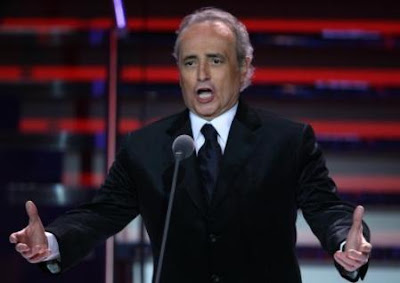
Dietrich Fischer-Dieskau & The Deep Voice Principle Note: Suitable baritones who fit the subject of this project were substantially more difficult to find than singers of previous voice types. Dietrich Fischer-Dieskau fit the bill perfectly because of his experience in a variety of operatic repertoire and in art song, but few others did. I have written at length about Fischer-Dieskau and then addressed this problem itself. Dietrich Fischer-Dieskau In order to study Dietrich Fischer-Dieskau I used assorted recordings of art songs along with three recordings of longer works. The assorted recordings of art song were of pieces I had in my own collection as well as the seminal Erlkönig. I used a video recording of Winterreise in 1979 with Alfred Brendel at the piano, a recording of Rigoletto under the direction of Rafael Kubelik in 1964, and an opera film of Le nozze di Figaro under Karl Böhm in 1...
A fellow voice major here at Lawrence caused me to recall an interesting trend in vocal classification among singers over the past century. Theoretically, beyond Soprano, Mezzo-Soprano, (the rare) Alto, Baritone, and Bass, voice types are governed by fächer a term hailing from Germany that describes a group of different fach (s) that further divide these voice types. Note that there are other terms that are used in countries that don't speak German, but by far fach is the most common word used to describe the idea. Rather than list fächer here, as that isn't the point of this article, I will direct you to look them up here on Wikipedia (note this list is not entirely accurate, as there are some omissions (such as absence of the leggiero tenor) and the terms are not clearly defined even among experts). All the great singers that opera lovers enjoy thinking about and listening to should technically be able to be classified by these fächer . However, save for a few except...
I remember reading Fred Plotkin's book Opera 101 some time ago. The book listed ten operas that would theoretically take a viewer from an easy, very accessible opera that they would (hopefully) like no matter what ( Rigoletto was his suggestion). The operas became increasingly less accessible until, at the end, were Wagner operas. Except these were not quite the end. The last of the ten was contained in a chapter called "Psychological Opera: Elektra ," or something along those lines. While Elektra is obviously a different Strauss opera than Salome , I found here the elements that might make this opera inaccesible to some, and definitely one to reserve for only the most prepared audience members. I admit this is my first time seeing Salome , but I must say that I was struck, I think particularly by this production, by how it is not just Salome , but essentially all the major characters, who are fraught with psychological problems. Synopsis & General Inform...
Comments
Post a Comment